Four Marc d'Alsace de Gewurztraminer AOC

November 29, 2022

Alsace has a long tradition of eaux de vie production, but only one Alsatian spirit boasts the status of an appellation d'origine contrôlée: Marc d'Alsace de Gewurztraminer. Established as an appellation since 1966 (though technically only AOC since 2010), the typicity of this pomace distillate is marked by the pungent aromatics that Gewurztraminer berries pack. The latest regulations allow up to 10g/L of added sugar, but fortunately I don't think there's any of that in today's line-up.

Metté (Alsace, France) – Marc de Gewurztraminer, miniature, 45%
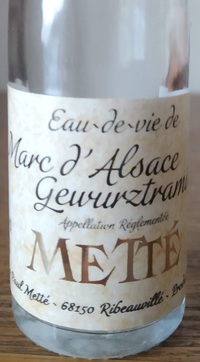
Picture of bottle Metté (Alsace, France) – Marc de Gewurztraminer, miniature, 45%

Until the closure of Distillerie Gilbert Holl at the beginning of 2020, Metté was one of three prominent eaux-de-vie producers in Ribeauvillé, the other now remaining being Windholtz. This one is bottled at the minimum required strength for the bottle to claim "appellation réglementée" (now AOC, as mentioned). On their website, they state the eau de vie is aged for at least a year in stainless steel.

Nose Fairly fragrant with freshly peeled lychees, bergamot and a little marzipan, a nose that is on the softer and rounder side of things. Orange wine gums, cut flowers, a touch of lemon scented cleaning product. A little water doesn't change much.

Palate Arrives quite gently before gripping on a strongly bitter, grassy note which develops into citrus cleaner, lychee, bergamot peel, becoming even more bitter as it develops. Finish is long with orange boiled sweets and bitter herbs. Water isn't very beneficial.

Comments A very pleasant nose, the palate presents a challenging bitterness but lots of pleasant floral and fruit notes.

Price around €48 per 50cl.

Score?6/10

Domaines Schlumberger (Alsace, France) – Marc de Gewurztraminer, 70cl, 48%
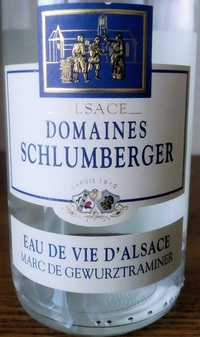
Picture of bottle Domaines Schlumberger (Alsace, France) – Marc de Gewurztraminer, 70cl, 48%

A prominent wine producer in the region. Even top wine producers don't always turn out the best distillate. Here, the label notes wood fired stills and ten years of aging (in steel or glass), which is a good sign, along with the healthy ABV.

Nose Very aromatic, bursting with lychee, battenburg, lemon juice, some bright green herbaceous notes. There is a distinctly savoury, saline note here, prominent next to the Metté: anchovies, soy sauce and celery, cherry tomatoes.

Palate Arrives with a punch - big, floral and fruity. Bags of lychee, some earth, old books, lemon zest. Develops on earl grey tea and cut flowers. Long finish, slightly citric, tea tannins, orange boiled sweets but also lychee continuing, nice balance. It takes a little water without much change.

Comments A less friendly nose than the Metté but the complexity is welcome, and the palate presents more balance. That combined with the edge on pricing mean this deserves a plus in the score.

Price around €49 per 70cl.

Score?6+/10

Zind-Humbrecht (Alsace, France) – Marc de Gewurztraminer (2000/2005, ash cask matured), 182 bottles, 37.5cl, 60.6%
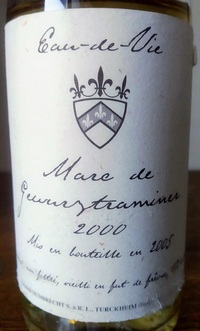
Picture of bottle Zind-Humbrecht (Alsace, France) – Marc de Gewurztraminer (2000/2005, ash cask matured), 182 bottles, 37.5cl, 60.6%

A lauded winery whose 1976 vintage MdG caused a stir recently amongst spirits enthusiasts. Here we have a couple of much younger offerings that have been aged somewhat unusually in ash, a relatively "neutral" wood. First up the 2000 vintage. Colour is white wine vinegar.

Nose Big but closed at strength: panettone, slightly vegetal (cabbage), potpourri, lemon peel. With water it opens up, adding lychee, raisins, a touch of burning rubber. Later, lemon bonbons are out in force, sour cherries, gingerbread, lemongrass. Again, a savoury, saline side here – celery and one anchovy.

Palate Very big at strength, leading with a intoxicatingly bitter, citric, herbal, floral assault. With substantial water it remains very big: concentrated, earthy, citric, it develops very perfumed (rose water), lychee, potpourri. Rather astringent overall. The finish is very long, remaining very floral, distant burning rubber but without much development.

Comments Extreme, almost rebarbatively rustic. Impressive, but hard to love. Revisit in 2080.

Price Unknown

Score?7/10

Zind-Humbrecht (Alsace, France) – Marc de Gewurztraminer (2001/2009, ash cask matured), 257 bottles, 37.5cl, 69.3%
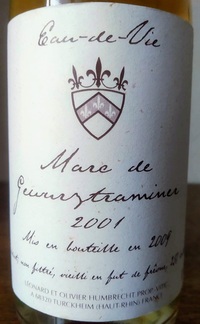
Picture of bottle Zind-Humbrecht (Alsace, France) – Marc de Gewurztraminer (2001/2009, ash cask matured), 257 bottles, 37.5cl, 69.3%

This one is actually over the 68.5% threshold for the AOC. This spirit at this strength is not for the faint-hearted. A touch darker colour than the 2000.

Nose Again – intense, concentrated but rather closed at strength: varnish, raisins, lemons, gingerbread. With water, lychees are out in force, that touch of rubber again, lemongrass, potpourri. Just a hair richer and rounder than the 2000, but broadly very similar.

Palate At strength, it's overwhelmingly intense. With a good measure of water, remains like a wall. Very perfumed, rose water, lychee, rowanberries, foliage, perfumed woods. Again rather astringent, earthy, citrus sour. Finish is endless: floral, bitter lychee. Again, very similar to the 2000, probably indistinguishable blind.

Comments As above, very impressive, but a bit monolithic. Should round off in glass over the next century?

Price Unknown

Score?7/10
Three Rowanberry Eaux de Vie Blind

October 22, 2022

Welcome to Clear Libations. For our inaugural post, we lined up a semi-blind tasting of three eaux-de-vie of rowanberry. Hardy pomes often considered as fit only for birds, the humble rowan is also a mainstay of European brandy production. Two top-shelf Austrian edelbrand were put head-to-head alongside a distilled maceration from Estonia, representing the more common method of working with these recalcitrant fruits.

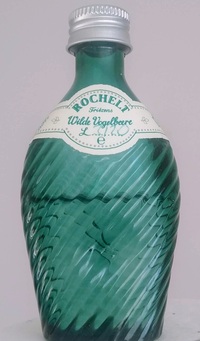
Rochelt (Tyrol, Austria) – Wilde Vogelbeere (Wild Rowanberry), 2007/2020, L.3/20, 52%

Picture of bottle Rochelt (Tyrol, Austria) – Wilde Vogelbeere (Wild Rowanberry), 2007/2020, L.3/20, 52%

Rochelt claim “up to” 80kg of fruit per litre, harvested from southern Finland. Unfortunately Rochelt do not state the vintage on their miniatures, but they confirmed this lot number corresponds to the 2007 vintage, which rested for 13 years. By the way, are there really cultivated rowanberries such that it would make sense to distinguish wild ones?

Nose Large and expressive, at first it is leafy, and earthy – cold damp earth. There is depth and complexity here, but it needs some time and a little water to resolve. Seaweed, lemon zest, almond oil, blackberries covered in mud, a muddy farmyard, and the tartness of rowanberries. Later there is some mint jelly, urinal cake (but nice), marzipan, and redcurrant jam. Certainly the most high volume nose, but if this is the Rochelt at 52% (ed: it is!), it wears the proof well. Love this nose.

Palate Initially, compared to glass B (ed: Reisetbauer), this is a bit less nippy and we have the impression of a more rested spirit, but still a tingling grip. It feels quite coiled-up neat, dark and earthy. With some water it stretches out – the initial punch is on slightly muddled, ethereal bitter and fruity rowan notes. Then we find a lot of tobacco, grass, and some of that farmyard. This leans in a tails-y direction which is really interesting, whether it be from resting, judicious use of tails in blending, or both. It has a very concentrated, dry, austere core, which demands time and patience but really grew on me. The finish is medium long, remaining dry, slightly bitter and herbal.

Comments An immediate standout on nosing the line-up, the palate here is challenging, and took some time to comprehend but is ultimately deserving of a high score. The presentation is gorgeous, but a wooden box for a miniature is a little over the top.

Price around €300 per 35cl.

Score?8/10

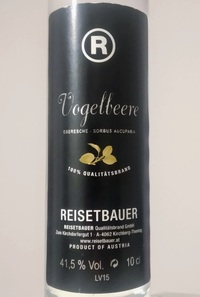
Reisetbauer (Upper Austria, Austria) – Vogelbeere (Rowanberry), 41.5%

Picture of bottle Reisetbauer (Upper Austria, Austria) – Vogelbeere (Rowanberry), 41.5%

Reisetbauer (est. 1994) has made this since 1996, and claims around 35kg of fruit per liter.

Nose Big, on sweet rowans, almond and marzipan, cherry liqueurs, closer to expectations of a rowan distillate. Quite round, with an impression of mild sweetness, even more so with a small drop of water. A slightly citric edge, twist of orange peel, and very slight chlorine. Certainly brighter and headier than sample A (ed: Rochelt).

Palate Neat, it's a little nippy, then develops nicely on bitter almond notes, and a touch of medicinal phenolics, ripe cherries. This is probably the most approachable glass, with a mild perceptual sweetness on the midpalate. Bitterness grows, in a pleasant way, with a little fresh orange. The finish is medium long, fading on the same notes. A small drop of water is beneficial but take care, it is fragile at this proof.

Comments A brighter more straightforward offering, with a lot of flavour, and rather tasty.

Price around €90 per 35cl.

Score?6/10

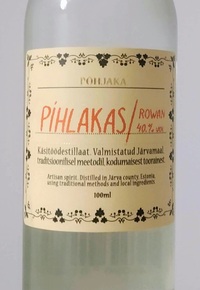
Põhjaka (Järva, Estonia) – Pihlakas (Rowanberry), bott. 29/10/21, 40%

Picture of bottle Põhjaka (Järva, Estonia) – Pihlakas (Rowanberry), bott. 29/10/21, 40%

The bottle tells us it is distilled using traditional methods and local ingredients, which is not exactly information. On their website, we learn this is distilled from an infusion of vodka made by the same producer. So, not exactly an even match for the others, but it presents itself as being in their company, and this method is presumably the most common when dealing with rowanberries, being so low in sugars.

Nose Very faint, almost nothing here. Freshly painted wall, a distant pecan, a little plain yoghurt.

Palate Mild arrival, quite thin, very little on the front and mid-palate. Eventually a mild bitterness, some of that fresh paint (but no solvents) and nuttiness. Short finish. Nothing offensive here but almost nothing happening either. Smooth, bland.

Comments As we said, this is somewhat apples to rowans, and it is reflected in the price gap, but considered as a rowanberry distillate this cannot hold a candle to the others.

Price around €35 per 35cl.

Score?3/10